Preparing your feet before a trail run

Preparing your feet before a trail run

Every trail run begins well before the starting line. Before looking up at the peaks, you need to look at... your feet! Because your success lies in how well you prepare them. No, stomach aches and digestive problems are not the only reasons why trail runners give up! In fact, on the UTMB® Mont-Blanc, 20% of dropouts are due to foot injuries.

Our role at Sidas, as a partner of the UTMB® World Series circuit, is therefore to help you take care of your feet so that you can reach the finish line of your dreams with peace of mind. Here is a complete step-by-step routine to optimise your comfort and avoid blisters, black toenails or pain that could compromise your goal of enjoyment or performance.

From anti-chafing cream to choosing the right socks and our advice on insoles, discover in this article the detailed protocol for preparing your feet before a trail run.

"On the UTMB® Mont-Blanc, 20% of dropouts are due to foot injuries. "

STEP 1:

UNDERSTAND WHY PREPARING YOUR FEET BEFORE A TRAIL RUN IS ESSENTIAL

First and foremost, the first step in the protocol is to understand why taking care of your feet before a trail run or ultra-trail is so important. Why? Because when you are convinced, you implement routines more conscientiously and consistently.

Moreover, while nutritional issues seem to be the main cause of dropouts, we often forget about foot injuries, which have turned more than one race into a real ordeal.

So what are the risks associated with poorly prepared feet?

  • Firstly, blisters and burns, often caused by repeated friction, which can be traced back to choosing shoes that are the wrong size or socks that lack breathability.
  • Next, black toenails, caused by repeated impact against the toes in poorly fitting shoes.
  • Finally, muscle or tendon pain, caused by the absence of insoles or lack of arch support.

"Blisters and chafing, often caused by repeated friction, which can be traced back to choosing shoes that are the wrong size or socks that lack breathability. "

STEP 2:

STRENGTHEN & TAKE CARE OF YOUR FEET BEFORE THE RACE

Trail runners are meticulous athletes. They methodically prepare their physical and mental condition, their nutrition and their equipment, but they often forget the fundamental tool that allows them to move forward: their feet! Here are our tips for getting yourself in the best possible shape for success ahead of race day:

  1. Follow a tanning routine to moisturise and strengthen your skin: The first option is to alternate between applying lemon juice in the morning and massaging in moisturising cream in the evening from 15 to 2 days before the race. This will increase the strength of your skin without drying it out.
  2. The second solution – favoured by the other half of our athletes – is to regularly apply anti-friction cream to your feet, from your toes to your heels, covering every square millimetre of skin, starting 15 days before the event. This anti-chafing cream, which is 99% natural, has a protective action that improves the elasticity, tone and ability of your skin to defend itself against chafing and moisture.

  3. Cut your nails carefully. At Sidas, we believe that a pedicure three weeks before the event is appropriate, and not necessarily excessive, given that you have been fully committed to your trail running project for several months. If you don't have a pedicure, we recommend that you cut your nails carefully, ideally not too short, a few days before the start. Never the day before!

  4. Do muscle strengthening exercises. Physical preparation and muscle strengthening have proven to be beneficial in terms of performance and injury prevention. But once again, the foot has been overlooked! Yes, squats, lunges and other exercises are essential for developing the strength of your hamstrings, calves and quadriceps, but specific exercises are just as important for your feet.

‘Commit to a tanning routine to moisturise and strengthen your skin.’

STEP 3:

TRAIL SHOES, INSOLES & SOCKS: CHOOSING THE RIGHT EQUIPMENT

Preparing your feet is essential, but so is gaining confidence in the equipment that protects them! Choosing your trail shoes, insoles and socks is therefore an absolutely crucial step that deserves careful consideration if you want to maximise your chances of crossing the finish line.

1. Choose a trail shoe in the right size.

Choosing the right size of running shoes is a real headache. The number of trail runners who have opted for a pair that is too big or too small is staggering. In fact, if you suffer from rubbing, blisters, black toenails or pain in specific areas of compression, it is highly likely that you are one of them.

Our tips for ensuring your trail shoes are the right size:

  • Leave a safety margin – also known as ‘comfort space’ – at the front of the foot. This is to avoid repeated impact of your toenails against the shoe, especially when running downhill.
  • Check that the heel is perfectly supported. This is key to ensuring precision and stability when running.

2. Invest in the best trail socks.

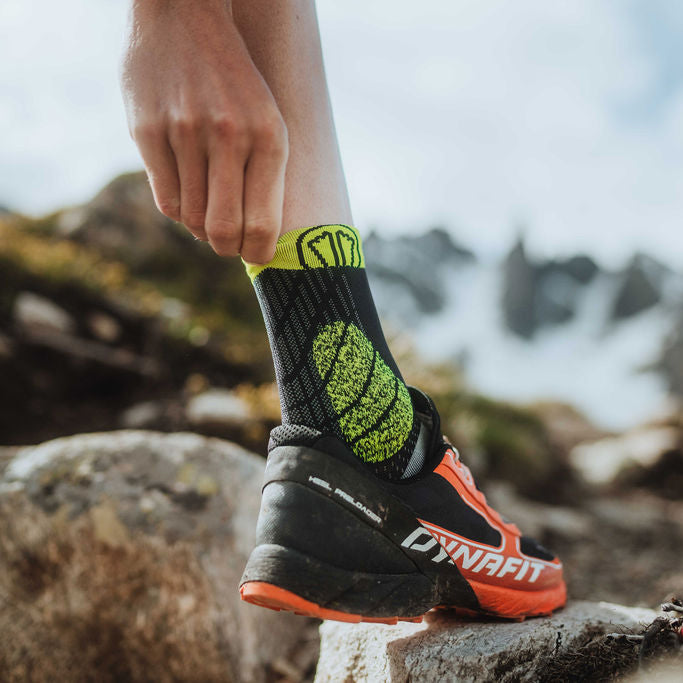
Enthusiasts often tend to spend most of their budget on shoes, underestimating the importance of socks. Our partnership with the UTMB® allows us to work closely with runners of all levels, observe their needs and develop products that meet them.

  • The T-Free® Trail sock features technology that frees the big toe, which plays a crucial role in your alignment and propulsion. It restores your foot's natural stability and propulsion.
  • The Trail Double sock is ultra-technical and designed to reduce the risk of blisters, especially over ultra-long distances. Its double construction means that friction occurs between the two layers of the sock rather than with the foot.
  • The Trail Ultra sock is lightweight, breathable and features Ultra Fit® technology, an innovation designed as an exoskeleton to compensate for the effects of muscle fatigue over long distances.
  • The Trail Protect sock – one of our best-sellers – often imitated but never equalled. It owes its success to its unrivalled comfort, provided by strategically placed reinforcements in sensitive areas of the foot.

3. Choose specific insoles for trail running

Foot comfort and performance depend on three factors, and the insole is the third of these. It may be the least visible, but it is by no means the least important!

The concrete benefits of the insole are manifold:

  • Better foot support
  • Enhanced stability and precision on unstable terrain
  • Greater cushioning
  • More even distribution of pressure
  • Optimal breathability

Our new 3Feet® Trail insoles, developed specifically for this activity, offer all these advantages. Thanks to 3Feet® Trail technology, which adapts the shape of the insole to the morphology of your arch, these little gems of innovation protect you from blisters, black toenails, fatigue and other muscle pain.

4/ Avoid new gear.

From experience, it's worth remembering! We see it at every UTMB World Series® event: too many trail runners start their target race with gear bought the day before at the event's trade show. Our recommendation is therefore clear: test your equipment before the big day. Prepare with it to gain confidence in your gear.

"In trail running, foot comfort and performance depend on three factors, and the insole is the third. It may be the least visible, but it's not the least important! "

STEP 4:

MAKE THE FINAL ADJUSTMENTS ON THE BIG DAY

Here are our tips for avoiding last-minute mistakes and fine-tuning the final details of your preparation:

  1. Dry your feet thoroughly before putting on your socks. Moisture is the worst enemy of comfort, which is why we place so much emphasis on the breathability of your equipment.
  2. Apply (generously) anti-chafing cream to the entire foot, especially the heel, arch and toes. Note that this cream, originally designed for your feet, can also prevent chafing on other parts of the body that you know are sensitive to friction.
  3. Adjust your socks. After putting them on, make sure that these socks, which you have already tested and approved many times, are completely wrinkle-free.
  4. Take care with your lacing. This is a crucial step, and not an accessory. Laces should be tied evenly – from the toes to the top of the instep – to avoid constriction at the top, and relatively loosely, as laces that are too tight can lead to tenosynovitis, i.e. inflammation of the extensor tendons that allow you to lift your foot when climbing.
  5. Pack a foot first aid kit and a spare pair of shoes and socks in your supplies. The Footcare Kit – a lightweight and compact emergency kit that includes 1 tube of anti-chafing cream, 1 tube of cryo gel, 2 big toe protectors, 4 toe protectors, 5 blister protectors and 1 pouch – will enable you to calmly manage crisis situations such as blisters and black toenails, maximising your chances of crossing the finish line!

You are now ready to enjoy the magical adventure that lies ahead! Treat yourself. Have fun!